Mouth Taping for Snoring: What the Research Says
No — mouth taping does not stop snoring, according to the best review we have. A 2025 review of 10 studies found no benefit in 8, and gains too small to matter in 2, according to its senior author. The safety side is clearer: taping can be risky with a blocked nose or undiagnosed sleep apnea.
Applies to: anyone who saw a social-media video about mouth taping for snoring and wants the evidence before trying it.
Safety warning: who should never try mouth taping for snoring
The 2025 review's authors concluded, verbatim: "there is a potentially serious risk of harm for individuals indiscriminately practicing this trend." The specific danger is asphyxiation risk when the nose is blocked — tape over the mouth removes your only open airway while you sleep.
Do not tape your mouth if: you have a cold, allergies, congestion, a deviated septum, or any trouble breathing through your nose · you snore loudly with gasping, choking, or breathing pauses (possible sleep apnea) · you have asthma, COPD, or another breathing condition · you are a child or care for one.
This page is education, not medical advice. Talk to a qualified clinician about snoring that includes breathing pauses — it needs evaluation, not tape. (Rhee et al., 2025)
If a social-media video told you to try mouth taping for snoring, read this before you buy the tape. A 2025 review of 10 studies found no benefit in 8 and gains too small to matter in 2, according to its senior author — and the reviewers warned the trend carries a potentially serious risk of harm. Below: exactly what the ten studies tested, why the two positive ones don't prove the trend, and the safer questions to ask instead.
So, does mouth taping work for snoring? For the general snorer, the honest answer is no. The only wins in the literature are two tiny pilots in carefully selected mild-apnea mouth-breathers — people screened to have clear noses, measured for one week or less, with no control group. Nothing in the research supports taping as a snoring remedy for the rest of us.
What the 2025 review pooled
The review is the closest thing to a real answer the mouth-taping-for-snoring question has. A systematic review doesn't run a new experiment; it finds every experiment already run, filters them by quality, and combines what they found. The search covered MEDLINE, Embase, and Google Scholar from February 1999 to February 2024 — a quarter century of literature — and only ten studies made the cut
Rhee J et al. (2025) — PRISMA systematic review, PLOS One 20(5):e0323643. Search: MEDLINE/Embase/Google Scholar, Feb 1999–Feb 2024. 120 records screened, 86 after dedup, 10 studies, 213 patients (233 total across studies). All studies rated poor quality. PROSPERO CRD42024509650. Full text at PMCThat scarcity is itself a finding. A trend with millions of views online rests on ten studies and 213 patients — all of them rated poor quality by the reviewers. Before we get to what the ten found, notice the asymmetry: the louder the claim, the thinner the evidence underneath it. This is the contradiction this page calls out about mouth taping for snoring — viral certainty built on a whisper of data.
The 10 studies at a glance
← Swipe to compare →| Study (what it tested) | Patients | Result | Quality / limits |
|---|---|---|---|
| Lee et al. 2022 — 3M silicone tape, 1 week, mouth-breathers with mild OSA | 20 | ✅ Small gain: median AHI 8.3→4.7; snoring index 303.8→121.1 | Retrospective pilot; no control group; nasal obstruction excluded |
| Huang & Young 2015 — porous oral patch, mild OSA habitual mouth-breathers | 30 | ✅ Small gain: median AHI 12.0→7.8/hr; snoring index 146.7→40.0/hr | Secondary summary; prospective but small and short |
| Remaining 8 studies — various tape/patch approaches | 163 | ❌ No benefit found | All rated poor quality; several discussed potential risks |
Two results out of ten is not a trend — it's a signal that only appears in the most carefully selected patients. And both positive studies measured people with mild obstructive sleep apnea who were habitual mouth-breathers with clear noses. Nobody studied the average snorer buying tape after watching a video. We'll unpack exactly why that matters in the next sections (Rhee et al., 2025)
One fair concession before we move on: the videos get the premise half-right. Nasal breathing during sleep genuinely is preferable to mouth breathing — the nose filters, warms, and humidifies air, and chronic mouth-breathing really does cause the dry mouth and sore throats people complain about (remember: 83% of Huang's patients reported dry mouth before taping). Where the trend goes wrong isn't the observation that mouth-breathing is unpleasant. It's the leap from "mouth-breathing is unpleasant" to "seal the mouth shut with tape" — a leap the research on mouth taping for snoring does not support, and whose risks the review states in unusually blunt language.
When reviewers call studies "poor quality," they mean specific things: tiny samples (the biggest positive study had 30 people), no control group to compare against (Lee 2022 had none — everyone got tape), very short follow-up (one week), and retrospective designs that invite cherry-picking. Poor quality doesn't mean the results are false. It means we can't trust them yet — and a responsible reviewer says so out loud, the way Rhee's team did.
It also means this: if a product or trend truly worked, better studies would exist by now. A quarter-century search turning up ten weak studies is what an absence of evidence looks like — and absence of evidence, for a practice with real risks, is a reason to stop, not a reason to try.
Who should not tape their mouth
The review's safety finding on mouth taping for snoring is the firmest thing in it. Rhee's team wrote that "there is a potentially serious risk of harm for individuals indiscriminately practicing this trend," and the mechanism is straightforward: tape seals the mouth, so a blocked nose leaves no open airway at all. During sleep — when you can't monitor yourself — that's an asphyxiation risk
Rhee J et al. (2025): "Two studies showed statistically significant improvement in established markers of sleep apnea such as AHI or ODI. Other studies showed that mouth taping offered no differences and even discussed potential risks including asphyxiation in the presence of nasal obstruction." Verbatim conclusion: "there is a potentially serious risk of harm for individuals indiscriminately practicing this trend." Full text at PMCHere is the part the viral videos skip: the two studies with positive results excluded people with nasal obstruction — or treated the obstruction first. The researchers knew the combination was dangerous, so they designed it out of their trials. Anyone copying the trend at home skips the screening the researchers considered mandatory.
That creates three groups who should never try mouth taping for snoring. First, anyone whose nose is unreliable: colds, allergies, congestion, a deviated septum, or a nostril that blocks when you lie down. Second, anyone with signs that snoring might be sleep apnea — loud snoring with gasping, choking, or pauses in breathing — because taping over suspected apnea delays the testing that actually matters. Third, anyone with asthma, COPD, or another breathing condition, and children, full stop.
What counts as a "blocked nose" for this purpose is broader than most people think. It isn't just a full cold. One nostril that narrows when you lie on your side counts. Seasonal allergies that flare at night count. A septum that deviates enough to make one side work harder counts — and many people don't know their septum deviates until congestion makes it obvious. The studies' standard was a reliably, fully clear nose; anything less was an exclusion. Your bedroom standard should be the same: if you can't say "my nose is completely clear right now" with confidence, the screening has failed and mouth taping for snoring is off the table.
Wondering how do you tell snoring from sleep apnea? That's the boundary question this whole page keeps returning to — and it's the reason what happens at a sleep apnea test? is worth reading before any bedroom experiment. A test measures what tape can't: whether your breathing actually stops.
One of the most-asked questions in our question bank is whether a deviated septum causes snoring. A deviated septum can narrow one nostril and make nasal breathing harder — which is exactly the profile the mouth-taping studies screened out. If one side of your nose regularly blocks, especially lying down, that is a screening failure for taping, not a reason to try it. The correct next step for septum-related snoring is an ENT or sleep-clinician assessment, where the fix is evaluated properly — sometimes it's nasal treatment, sometimes it's positional, and sometimes the snoring has nothing to do with the septum at all.
What to ask about instead
The most useful question isn't "which tape?" It's "why is my mouth open at night?" — because the answer points at the fix. If the answer is congestion, the fix is nasal: treating allergies, clearing a cold, or having persistent blockage evaluated. If the answer is position — back-sleeping lets the tongue fall back — the fix is positional: side-sleeping support, which the research on do anti-snoring pillows actually work? examines with real trials.
If the answer is "I don't know, but the snoring is loud and there are pauses," the fix is neither tape nor a pillow — it's a sleep evaluation. Snoring with witnessed breathing pauses, gasping, or choking sits on the apnea side of the boundary, and apnea is diagnosed with objective testing, then treated with pressure therapy or clinician-chosen alternatives. Curious about the landscape beyond tape? Start with what non-surgical snoring options exist? — it maps what to try first, in what order, and why. And if you want the apnea question answered head-on, can a pillow help sleep apnea? gives the guideline-first version of this same honesty: comfort aid, never treatment.
One more honest note: mouth tape is cheap, and cheap feels low-risk. It isn't. The price of the tape is irrelevant next to the price of a blocked airway at 3 a.m. — which is why the review's authors chose their words carefully: a potentially serious risk of harm for people practicing the trend indiscriminately. Cheap plus risky is still risky.
Questions worth asking a clinician
If you take one thing from this page on mouth taping for snoring to an appointment, make it these questions. They cost nothing, carry no risk, and they target causes instead of symptoms:
- "Why do I mouth-breathe at night?" — congestion, anatomy, position, or habit each point at a different fix.
- "Could my snoring be sleep apnea?" — loud snoring with gasping, choking, or pauses earns a sleep evaluation, not an experiment.
- "Is my nose reliably clear in sleep?" — if the answer is no, every mouth-sealing idea is off the table, permanently.
- "What should we try first?" — a clinician sequences options by evidence; tape doesn't make the list, and the review explains why.
Bring the review with you — Rhee et al. 2025, PLOS One — and you'll have a better conversation than any video comment section. The point of reading the research on mouth taping for snoring isn't to win an argument online. It's to walk into that appointment already asking the right questions.
Why the two positive studies don't settle it
Fairness first: the two positive studies are real studies with real measurements, and dismissing them would be as dishonest as hyping them. Lee and colleagues (2022) followed 20 mouth-breathers with mild obstructive sleep apnea through one week of 3M silicone hypoallergenic tape, measuring sleep with a home test. Median AHI fell from 8.3 to 4.7 events per hour — a 47% drop — and the snoring index fell from 303.8 to 121.1, also about 47%. Thirteen of the 20 were classed as responders. On paper, that looks like a win
Lee YC et al. (2022) — Healthcare 10(9):1755. Retrospective preliminary study, n=20 mouth-breathers with mild OSA, 1 week of 3M silicone hypoallergenic tape, ApneaLink home sleep test. Median AHI 8.3→4.7 event/h (p=0.0002); supine AHI 9.4→5.5 (p=0.0001); median SI 303.8→121.1 (p=0.0002); 13/20 (65%) responders (≥50% SI reduction). No control group; nasal obstruction excluded or pre-treated. Full text at PMCHuang and Young (2015) tested a novel porous oral patch on 30 patients with mild OSA and habitual open-mouth breathing. Median AHI dropped from 12.0 to 7.8 per hour; snoring intensity eased from 49.1 to 41.1 decibels; the snoring index fell from 146.7 to 40.0 per hour. Notably, before taping, 83% of these patients reported dry mouth and 53% reported drooling — they were extreme mouth-breathers, not typical snorers
Huang & Young (2015) — Otolaryngol Head Neck Surg 152(2):369–373, via secondary summary. Prospective study, n=30 mild-OSA habitual open-mouth breathers, 3-layer porous oral patch (silicone sheet, polyurethane foam, polyurethane film). Median AHI 12.0→7.8/hr; snoring intensity 49.1→41.1 dB; SI 146.7→40.0/hr; retropalatal space 7.4→8.6 mm. Before taping: 83% dry mouth, 53% drooling.Now the context that changes what those numbers mean. Both studies were tiny — 20 and 30 people. Neither had a control group, so we can't separate tape from placebo, from simply sleeping differently while being measured, or from night-to-night variation in apnea severity (which is large). The measurement periods were days to weeks; nothing tells us what happens over months. And the patients were the easiest possible cases: mild apnea, habitual mouth-breathers, clear noses — pre-screened for the one thing that makes taping dangerous.
This is why the review's senior author described the two positive findings as minimal benefit, not clinically significant — and why the review's overall verdict lands where it does: 8 of 10 studies no benefit, 2 with gains too small and too fragile to matter. The honest read of Lee and Huang isn't "taping works." It's "taping might do something small, in a narrow slice of patients, under clinical supervision — and we need real trials to know." Those trials don't exist yet.
Put the arithmetic together: the entire positive case for mouth taping for snoring is 50 patients across two short pilots. The negative case is 163 patients across eight studies — plus the review team's safety warning. That ratio is what the videos never show you, and it's why this page leads with the review instead of the trend.
⚠ What the research cannot tell you yet
- No general-population trial exists. Nobody has tested mouth taping on ordinary snorers — only on screened mild-apnea mouth-breathers.
- No long-term data exists. The longest positive measurement ran about a week. Adhesive on skin nightly for months is unstudied.
- No guideline endorses it. The review notes no mention of mouth taping in international sleep guidelines, and the American Academy of Sleep Medicine has no position statement on it.
- The risk side is one-sided. Benefits are small and uncertain; the harm mechanism (blocked nose + sealed mouth) is direct and physical.
Snoring is not what the studies mostly measured
Here is a subtlety the videos never mention. When Lee 2022 reported a 47% drop, the headline number was AHI — the apnea–hypopnea index, which counts how many times per hour breathing pauses or shallows. When Huang and Young reported their wins, they led with AHI too. These are apnea markers: they measure a disease process, not a noise. Snoring is the sound of soft tissue vibrating in a narrowed airway. The two overlap — heavy snorers are more likely to have apnea — but they are not the same measurement, and they don't move together reliably.
Why does that matter for mouth taping for snoring? Because the trend promises the noise will stop, while the evidence — such as it is — talks about pause counts in mild-apnea patients. Even the snoring numbers the pilots did report need context. Lee's snoring index fell from 303.8 to 121.1 per hour; Huang's from 146.7 to 40.0 per hour, with snoring intensity easing from 49.1 to 41.1 decibels. Those are real reductions in carefully selected mouth-breathers — and the review's senior author still judged the overall gains minimal and not clinically significant. Small improvements in the easiest patients, in the shortest studies, with no controls: that is the entire positive case.
Meanwhile, the eight studies that found no benefit tested broader groups — and none of them produced a snoring win for ordinary snorers either. So the scoreboard for mouth taping for snoring, stated plainly: the noise outcome has no good evidence, the apnea-marker outcome has two fragile pilots, and the safety outcome has a direct warning. When someone shows you a single impressive percentage, ask which outcome it measured — and in whom.
Three metrics, three different things. AHI (apnea–hypopnea index) counts breathing pauses and shallow-breathing episodes per hour of sleep — the standard severity gauge for sleep apnea. ODI (oxygen desaturation index) counts how often blood oxygen dips — the harm gauge. Snoring index counts snoring episodes or their intensity — the noise gauge. A treatment can move one without moving the others: a quieter night isn't automatically a safer one, and fewer pauses don't guarantee silence. Honest reporting names the metric; marketing picks the prettiest one.
The nasal-breathing-first rule
Strip away the trend and you're left with a screening problem. Mouth taping is only even discussable when nasal breathing is already working — and if nasal breathing is already working, the taping has little left to fix. That's the quiet paradox of the whole trend: the people who can tape safely are the people least likely to need it.
The diagram below is the screening logic the studies used, translated for a bedroom mirror. Read it as a flowchart, not a recommendation — because where it ends, for most people, is "do not tape."
Reading the chart: this is the studies' own screening logic, not a how-to. Notice how narrow the path is — three failure points, and the "pass" lane still ends at "the review found no general benefit." A screening this strict is the evidence telling you something.
The viral claim
"Mouth taping trains you to breathe through your nose — your nose just needs practice."
What the evidence says
No study in the review showed tape retraining anyone's breathing. If your nose is clear, you likely already nose-breathe in sleep. If it's blocked, tape is a hazard, not a trainer — that's the review's asphyxiation warning.
Nose breathing isn't a skill that needs training; it's the default your body uses whenever the airway allows it. The videos invert cause and effect: people who mouth-breathe at night usually do so because something narrows the nasal airway — congestion, anatomy, position. Sealing the mouth doesn't widen the nose. It just removes the backup route. And if you've ever woken with a sore throat from snoring — one of our most-asked questions — that dryness comes from mouth breathing, but the fix is clearing the airway, not sealing the exit.
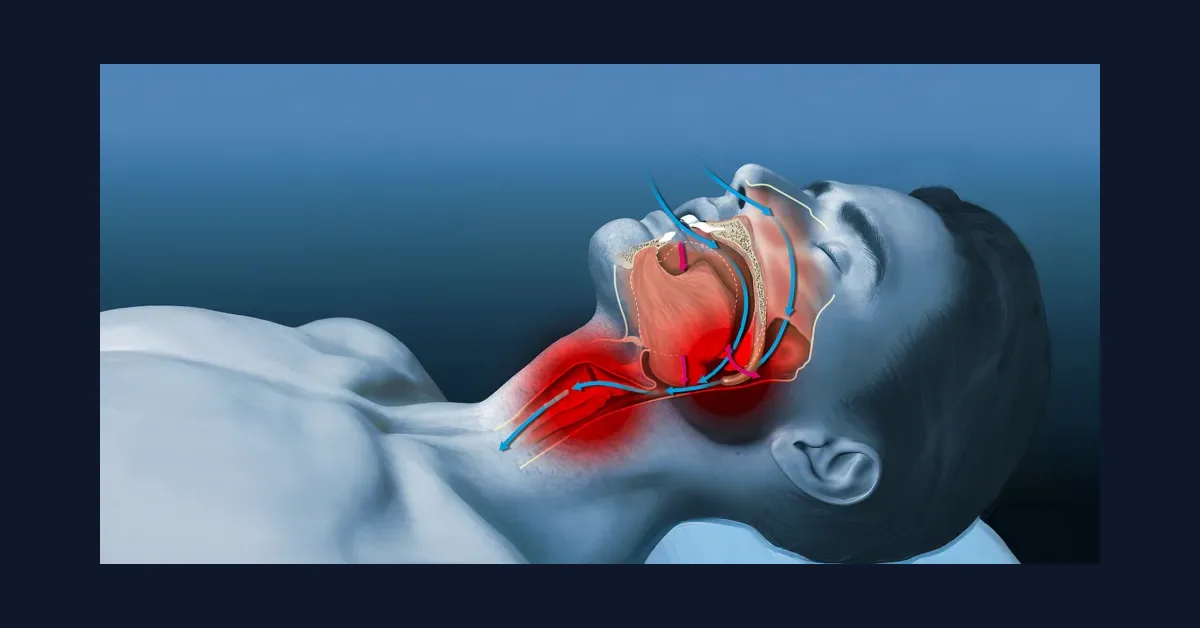
During sleep, muscle tone drops throughout the airway, the tongue relaxes backward, and lying flat lets gravity narrow things further. If the nasal passage is even partly congested, airflow shifts to the mouth — which dries it, vibrates the soft tissues (the snore), and can worsen the very dryness the taping videos promise to fix. The honest sequence is: find out why the mouth opens (congestion? anatomy? position? apnea?), then address that cause. Tape addresses none of them — it only hides the symptom while adding risk.
How to read viral health claims like this one
Mouth taping is a case study in how health trends outrun their evidence, and the pattern repeats. Step one of the pattern: a plausible mechanism ("nose breathing is healthier") gets stretched into a prescription ("seal your mouth shut"). Plausible isn't proven — plenty of plausible ideas fail in trials, and the review exists precisely to check.
Step two: the evidence shown is always the best two studies, never the other eight. This is selection bias wearing a lab coat. When someone cites Lee 2022's 47% AHI drop, ask what they left out: 20 people, no control group, one week, mild cases only, blocked noses excluded — and a review team that still called the gains minimal.
Step three: the safety question gets answered with vibes ("it's just tape!") instead of data. Tape is "just" an airway obstruction you apply to yourself while unconscious. The review's authors — sleep researchers, not alarmists — used the phrase "potentially serious risk of harm." When the cautious people use strong words, listen.
Step four: the testimonial trap. "It worked for me" is the most persuasive and least informative evidence there is. Snoring varies night to night; anyone who tapes on a good night becomes a believer, and believers post videos while the unimpressed stay quiet. Ten studies with 213 patients — the entire published record on mouth taping for snoring — outweigh a thousand sincere anecdotes, because anecdotes can't separate the tape from the noise. The review can, and did.
The three checks work on the next trend too: count the studies, check the exclusions, find the guideline. If a trend can't survive those three questions, it doesn't matter how many views it has. Views aren't peer review.
The 4-question safety screener
🛡️ Safety-first screener: should this even be on the table?
Answer honestly. 0 of 4 answered
1. Can you breathe comfortably through your nose, mouth closed, for two full minutes right now?
2. Do you have a cold, allergies, congestion, a deviated septum, or one nostril that blocks lying down?
3. Has anyone seen you gasp, choke, or pause breathing in your sleep?
4. Do you have asthma, COPD, another breathing condition — or is this for a child?
Questions people actually ask
Quick answers on mouth taping for snoring, each grounded in the review. Every answer below comes from the 2025 systematic review or the studies it pooled — the same evidence this whole page on mouth taping for snoring is built on.
Does mouth taping work?
Is mouth taping safe?
Can mouth taping treat sleep apnea?
Why do people tape their mouths at night?
Does a blocked nose make mouth taping dangerous?
What should I try instead of mouth taping for snoring?
Does the AASM recommend mouth taping?
Does mouth taping train you to breathe through your nose?
Key takeaways
- A 2025 review of 10 studies found 8 showed no benefit from mouth taping for snoring; 2 tiny pilots showed gains too small to matter clinically.
- The review's verbatim safety warning: a potentially serious risk of harm — including asphyxiation risk with nasal obstruction.
- The positive studies excluded everyone with blocked noses — the screening the videos skip.
- No international sleep guideline mentions mouth taping; the AASM has no position statement on it.
- Ask why your mouth opens at night (congestion? position? apnea?) instead of sealing it — and get snoring with breathing pauses evaluated.
- The trend's whole positive case is 50 patients in two short pilots — against 163 patients in studies that found nothing, plus a direct safety warning.
Last reviewed: 2026-11-01 by Honest Review Hub Editorial Team
References
- Rhee, J., Iansavitchene, A., Mannala, S., Graham, M. E., & Rotenberg, B. (2025). Breaking social media fads and uncovering the safety and efficacy of mouth taping in patients with mouth breathing. PLOS ONE, 20(5), e0323643. https://pmc.ncbi.nlm.nih.gov/articles/PMC12094774/
- Lee, Y. C., et al. (2022). Preliminary study of mouth taping in mouth breathers with mild obstructive sleep apnea. Healthcare, 10(9), 1755. https://www.ncbi.nlm.nih.gov/pmc/articles/PMC9498537/
- Huang, T. W., & Young, T. H. (2015). Novel porous oral patches for patients with mild obstructive sleep apnea and mouth breathing. Otolaryngology–Head and Neck Surgery, 152(2), 369–373. https://doi.org/10.1177/0194599814559383 (via secondary summary — labeled as such)
How we researched this page
We mapped 5 reader questions for this page from the collected "people also ask" ledger, on mouth taping for snoring, then traced every claim to 3 published sources: the Rhee et al. 2025 PRISMA systematic review (10 studies, 213 patients, literature searched February 1999–February 2024, PROSPERO CRD42024509650), the Lee et al. 2022 pilot (n=20), and the Huang & Young 2015 study (n=30, via secondary summary — labeled as such). No manufacturer claims were used as evidence. The E-GAP on this topic was closed 2026-11-01 with the full review plus both positive pilots retrieved; the page's verdict follows the review's own: negative overall, with a real harm warning. Full method: how we research.