Positional Sleep Apnea Explained: Back vs Side Sleeping
Positional sleep apnea means your apnea is at least twice as bad on your back as on your side — and about half of all OSA patients fit that pattern. But "positional" describes a pattern, not a diagnosis you can make yourself: only a sleep test that records body position can confirm it.
Applies to: anyone whose sleep test mentioned position — or who wonders why side-sleeping changes their nights.
A pillow can support comfort and side-sleeping; it does not treat sleep apnea
Positional or not, sleep apnea needs proper diagnosis and treatment — talk to your doctor. The pattern on this page is identified by a sleep test, and what to do about it is a clinician's decision. Nothing here replaces that evaluation.
Seek evaluation promptly if: breathing pauses are witnessed during sleep · there is gasping or choking at night · daytime sleepiness interferes with driving, work, or safety. This page is education, not medical advice. (AASM, 2019)
If a sleep test mentioned position — or a partner swears you're fine on your side and terrible on your back — this page explains what "positional" actually means. In one AASM journal study, a position device matched CPAP for people whose apnea happened only on the back. The key phrase is "only on the back," and only a sleep test can show that. That is the single most important sentence about positional sleep apnea on this page. Below: the definition, the 2x rule, how testing identifies the pattern, and what clinicians may suggest.
So what is positional sleep apnea? It's obstructive sleep apnea with a strong position dependence: breathing pauses at least twice as frequent on the back (supine) as off it. Gravity is the mechanism — supine, the tongue and soft tissues fall backward into the airway; on the side, they fall sideways. About half of OSA patients show this pattern, but the only way to know you're one of them is a test.
What positional means
Definition: positional obstructive sleep apnea is OSA in which the apnea–hypopnea index (AHI) is at least twice as high while sleeping on the back (supine) as while sleeping in other positions. That "twice as high" threshold — the 2x rule — is the standard researchers use to classify the pattern. About half of all patients with OSA meet it. (de Vries et al., 2015)
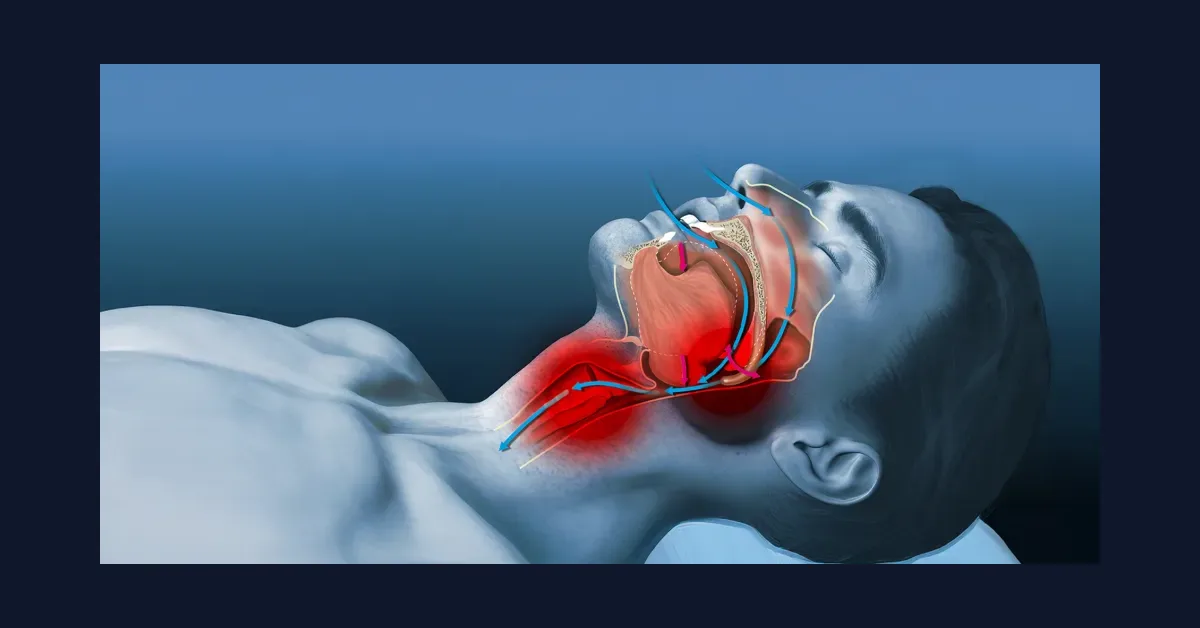
The mechanism is gravity, and it's worth picturing. When you lie on your back, the tongue and the soft tissues of the throat fall backward — into the airway. When you roll onto your side, they fall sideways — away from it. In people with the positional pattern, that single change in direction is the difference between an airway that repeatedly closes and one that mostly stays open. Nothing about your throat changes; only the direction gravity pulls.
Two misunderstandings need clearing up early, because they shape everything downstream. First: positional does not mean mild. The pattern describes where apnea concentrates, not how severe it is — someone can have severe apnea that happens to be positional, or mild apnea that isn't. In de Vries and colleagues' 2015 study, the median AHI before positional treatment was 14.5 events per hour — squarely in the moderate range — and these were positional patients
de Vries et al., Journal of Clinical Sleep Medicine 2015. About half of all patients with OSA have positional OSA (Cartwright definition: AHI at least 2x higher supine than non-supine). In the treatment cohort: 27/40 (68%) treatment success; median AHI 14.5→5.9. Full text at PMCThird, a distinction the search data shows people want: positional sleep apnea is still obstructive sleep apnea — the same disorder, the same airway, the same need for testing and treatment. "Positional" is a subtype label, not a separate condition and not a milder one. Someone with positional sleep apnea and someone with non-positional apnea both have OSA; they differ only in how much position drives their numbers, which is why the test — not the label — guides what happens next.
Second: positional does not mean "just don't sleep on your back." Knowing the pattern is positional tells you what is happening, not what to do about it — because staying off your back all night, every night, is a treatment-adherence problem, and because the pattern still needs a clinician to interpret it against your full results. The definition is the starting line, not the finish.
This guide draws on five primary sources — the AASM's 2019 guideline, the AAFP's 2021 review, the FDA's 2024 consumer guidance, de Vries et al. 2015, and NHS guidance last reviewed May 2026 — plus three secondary meta-analyses, current as of November 2026. No manufacturer claims were used as evidence.
The threshold comes from Cartwright's early work on position-dependent apnea, and it stuck because it's both simple and discriminating: at twice the supine rate, position is clearly driving the disease rather than just nudging it. Researchers still use it as the standard classification — which is why you'll see "Cartwright definition" or "Cartwright's criteria" in papers. It's a research convention, not a law of nature; your clinician interprets your numbers in context, not by arithmetic alone.
How testing identifies it
Here's the open loop from the top of the page, paid off: why only testing can tell. Positional sleep apnea is a claim about measured rates in different positions — events per hour on the back versus events per hour off it. You cannot feel your AHI. Your partner cannot count your apneas by watching. A phone app cannot measure airflow or oxygen. Only a sleep test records all three — breathing, oxygen, and position — simultaneously, through the whole night
AASM clinical practice guideline: PAP treatment of adult OSA. J Clin Sleep Med 2019;15(2):335–343 (PMID 30736887). Good-practice statements: diagnosis must rest on objective sleep testing. PubMed recordWhat the test produces is two numbers that matter here: your AHI while supine and your AHI while non-supine. The lab also grades overall severity on the standard bands — 5 to 14 events per hour is mild, 15 to 30 moderate, above 30 severe — which is why guidance keeps saying "mild-to-moderate": those bands are where positional approaches are most often discussed (NHS, 2026). Then comes the comparison: supine AHI at least twice the non-supine AHI, and the positional label applies.
📏 The named rule: the 2x rule
AHI on the back ≥ 2 × AHI off the back = positional. That's the whole rule — the Cartwright definition in one line. Example: 24 events/hour supine versus 10 off the back clears the bar; 24 versus 16 does not. Your lab does this arithmetic for you; the rule is here so the report makes sense when you read it.
A practical note on test types: both home sleep tests and in-lab studies can capture position, though labs measure it more precisely — in-lab studies use video and multiple sensors, while home tests typically use a chest-worn position sensor. Either way, what matters for identifying positional sleep apnea is that position is recorded at all alongside airflow and oxygen. A test that doesn't track which way you were facing can't identify a positional pattern, no matter how good its other sensors are. What matters is that position is recorded at all — a test that doesn't track which way you were facing can't identify a positional pattern. If your report mentions supine versus lateral AHI, the lab did its part; the rest is interpretation, which belongs with the clinician. Curious what the night itself involves? What happens at a sleep apnea test? walks through it step by step.
Feeling better on your side is a real observation — but it's not a measurement. People feel better on their side for many reasons: less snoring noise, fewer awakenings, a partner who sleeps through. None of those is an AHI. Worse, the feeling can mislead in both directions: some positional patients feel fine (their apnea is silent), and some non-positional patients feel better on their side for unrelated comfort reasons. The test exists precisely because feelings and physiology diverge. Trust the feeling enough to mention it; trust the test enough to decide by it.
What clinicians may suggest
Once testing confirms the positional pattern, the conversation changes from "what is it" to "what do we do about it" — and that conversation belongs with a clinician, because the answer depends on severity, symptoms, and the rest of your results. What follows is what clinicians may discuss, drawn from institutional guidance — not a recommendation for you specifically.
The NHS's self-help guidance puts it plainly: sleep on your side — try taping a tennis ball to the back of your sleepwear, or buy a special pillow or bed wedge to help keep you on your side . The tennis ball is the low-tech classic: it makes back-sleeping uncomfortable enough that you roll off it without fully waking. The pillow or wedge is the comfort version of the same idea.
NHS guidance on sleep apnoea (page last reviewed 11 May 2026): "Sleep on your side - try taping a tennis ball to the back of your sleepwear, or buy a special pillow or bed wedge to help keep you on your side." AHI bands: 5–14 mild / 15–30 moderate / >30 severe. NHS sleep apnoeaThe FDA's consumer guidance (content current February 2024) frames the pillow question directly: a special pillow or other bed device may help mild to moderate positional OSA. The mechanism it names is the one this page keeps returning to — positional apnea is caused by lying on your back, and the device helps you stay on your side, where gravity doesn't pull the tongue or throat into the airway . Note the careful scoping: mild to moderate, positional, may help. Every qualifier is doing work.
FDA consumer update (content current 2024-02-23): "A special pillow or other bed device may help mild to moderate positional OSA. Positional obstructive sleep apnea is caused by lying on your back (face-up) during sleep. A special pillow or similar bed device can help you stay sleeping on your side where gravity does not cause your tongue or throat to block your airway."Beyond bedroom aids, clinicians may discuss dedicated positional therapy — devices that train or enforce side-sleeping, including vibrotactile trainers that nudge you when you roll supine — and, where severity or symptoms warrant it, CPAP or other therapies regardless of position. The pattern being positional opens a door; it doesn't choose which room you walk into. If the broader question on your mind is whether a pillow can do more than aid positioning, can a pillow help sleep apnea, according to guidelines? gives the full guideline-first answer: comfort aid, never treatment.
This page says "may suggest" on purpose. Positional therapy's evidence is real but moderate (the AAFP's 16–40% figure), adherence is a known problem — de Vries found 65% of patients were no longer using positional therapy at around 13 months — and individual anatomy varies. A clinician weighs your severity bands, your symptoms, your other conditions, and your likelihood of actually sticking with a positional routine. That judgment call is the job; this page's job is making sure you arrive at it informed.
Back vs side: the mechanism
Everything about positional sleep apnea is this diagram. The airway is a soft tube; the tongue is a large muscle anchored at the front; gravity pulls straight down. Sleep on your back and "down" means "into the airway." Sleep on your side and "down" means "toward the mattress, away from the airway." No new anatomy, no complicated physiology — just geometry.
Reading the chart: same head, same gravity, different direction of pull. This is the entire physical basis of positional sleep apnea — and why "just sleep on your side" is real advice with a real mechanism, even though converting advice into all-night adherence is where the difficulty lives.
Two implications follow that most summaries skip. First, the mechanism explains why positional apnea clusters where it does: anyone whose airway is marginally narrow — fine in one direction, collapsing in another — will show the pattern. Second, it explains the limits: if the airway collapses in every position, no amount of side-sleeping fixes it, and the pattern isn't positional at all. The diagram is honest in both directions.
What studies found about positional therapy
The most-cited positional-therapy study in this space is de Vries et al. (2015), published in the Journal of Clinical Sleep Medicine — the same paper that documented the "about half" prevalence figure. Its treatment results are worth reading in full, because they contain both the promise and the problem. Among 40 positional patients treated with a position device, 27 (68%) achieved treatment success, and median AHI fell from 14.5 to 5.9 events per hour — a drop that moves most patients down a full severity band
de Vries et al., J Clin Sleep Med 2015. Positional therapy cohort: 27/40 (68%) treatment success; median AHI 14.5→5.9; 65% no longer using positional therapy at ~13 months. Full text at PMCThen the follow-up finding that keeps the first one honest: at around 13 months, 65% were no longer using the positional therapy. The treatment worked when used; most people stopped using it. That is the adherence problem in one statistic — and it's why clinicians discuss positional therapy as a strategy that needs a plan for the long term, not just the first month. A therapy you abandon is a therapy that stops working the day you abandon it.
Newer evidence sharpens the picture without changing its shape. A 2023 systematic review and meta-analysis of vibrotactile positional therapy (18 studies, including 10 randomized trials) found a mean AHI reduction of 9.19 events per hour and a roughly one-third reduction in time spent on the back — real, measured effects — but minimal impact on daytime sleepiness and quality of life, with short follow-up across the studies. (Secondary source — reported via the evidence review.) And a 2025 meta-analysis of 19 randomized trials (1,231 patients) found sleep-position trainers beat placebo on supine AHI by 7.46 events per hour — again real, again smaller than CPAP's effect, with fewer device-related complications than CPAP (odds ratio 0.29). (Secondary source — labeled as such.)
One more secondary finding for completeness, since side-sleeping isn't the only positional idea: de Barros Souza et al. (2017) tested 7.5-degree head-of-bed elevation in 52 mostly mild-to-moderate patients and found median AHI fell from 15.7 to 10.7 — a 31.8% reduction — with minimum oxygen saturation rising from 83.5% to 87%. Interesting, small, and secondary-reported here — the kind of result that deserves a bigger trial before it becomes advice.
The through-line for back sleeping sleep apnea questions: the position effect is real, measurable, and moderate. For side sleeping sleep apnea questions: side-sleeping is the best-supported positional change, with the adherence catch above. Neither sentence makes position a treatment — they make it a factor, and factors get weighed by clinicians, not by product pages.
"Success" in the study wasn't "cured." It was a defined threshold of AHI reduction — the kind of operational definition researchers use so results can be compared across studies. The median AHI of 5.9 after treatment sits just above the normal-range cutoff, which is genuinely good — and it also shows why medians can mislead: half the patients did worse than 5.9. Always read the median alongside the success rate (68%), not instead of it.
Positional therapy vs CPAP
This is FAQ question two, and it deserves the direct answer the 4P row promises: in head-to-head evidence, positional therapy is less effective than CPAP overall — while causing fewer device-related complications (odds ratio 0.29 in the 2025 meta-analysis, meaning roughly a third the complication odds). Less effective, better tolerated: that's the trade-off in one line, and different patients will weigh it differently
Frontiers in Medicine meta-analysis (2025; 19 RCTs, n=1,231 — secondary). SPT vs placebo supine AHI mean difference -7.46 (95% CI -11.42, -3.49); SPT less effective than CPAP overall; fewer device-related complications vs CPAP (OR 0.29, 95% CI 0.12–0.72). AlQarni et al., Thorax 2023 (SR + meta-analysis, 18 studies incl. 10 RCTs — secondary): vibrotactile PT AHI MD -9.19 events/h; %Tsupine -32.79%; daytime sleepiness/QoL effects minimal, short follow-up.The AAFP's 2021 review says the same thing from the other direction: positional therapies improve apnea measures 16 to 40 percent versus no treatment, with smaller reductions than CPAP (AAFP, 2021). Two independent evidence streams, same ordering. When the literature agrees with itself this cleanly, the page's job is to report the agreement, not to shop for a friendlier one.
Where does that leave the person with purely positional, mild apnea who hates the idea of a machine? With a legitimate conversation to have — not a decision to make alone. The opener's AASM-journal finding (a position device matching CPAP for people whose apnea happened only on the back) shows the ceiling of what's possible in the narrowest, best-selected group. The meta-analyses show the average. Your clinician's job is figuring out which group you're in — which is why the test comes before the therapy, every time. For the practical side of combination nights, what pillow setups do side-sleeping CPAP users use? covers the comfort lane.
The myth: "positional means mild"
The comforting story
"It's only positional — so it's mild, so I can ignore it." Pattern mistaken for severity, severity mistaken for safety.
What the evidence says
Positional describes where apnea concentrates. De Vries's positional patients had a median AHI of 14.5 — moderate, not trivial. And "positional" never means "tested": the pattern is identified by a sleep study, full stop.
The myth is tempting because it turns a diagnosis into a dismissal. But follow it through: if positional meant mild, the de Vries cohort — selected for being positional — would cluster at the mild end. They didn't. A median AHI of 14.5 sits in the moderate band (15–30 is moderate per NHS bands; 14.5 knocks on the door). Some positional patients are mild; some are moderate; a few are severe. The position tells you the shape of the problem. Only the test tells you its size.
There's a second, quieter version of the myth: "my snoring is positional, so it's not apnea." This one confuses the pattern with the diagnosis — as if positional sleep apnea were a rumor you could dismiss by renaming it. The pattern is real and measurable; whether it amounts to apnea, and how severe, is what the test determines. A reassuring label is not a reassuring result.
There's a third version, aimed at products: "positional means I just need the right pillow." The FDA's own scoping answers that — a special pillow may help mild-to-moderate positional OSA stay on the side. "May help stay on the side" is positioning support, not therapy, and "mild-to-moderate" is a band only a test can place you in. Snoring and apnea are different measurements — loud positional snoring without breathing pauses is a different situation from positional apnea, and telling them apart is exactly what how do you tell snoring from sleep apnea? is for. Don't let the pattern name do the diagnosing. That's the test's job.
Your testing roadmap
- Notice. The signs that start the journey: loud snoring, witnessed breathing pauses, gasping or choking at night, daytime sleepiness that interferes with life. Signs can present differently between people — how do sleep apnea signs differ in men and women? — so don't rule yourself out on a stereotype.
- Talk. Bring the observations to a clinician — yours, and your partner's if you have one. Witnessed pauses are among the most useful things you can report.
- Test. A home or in-lab sleep study that records airflow, oxygen, and body position. The position sensor is what makes the positional question answerable — confirm it's part of your test.
- Read the two numbers. Your report gives AHI overall and AHI by position. Supine versus non-supine is the comparison this whole page is about.
- Apply the 2x rule — with a clinician. Back AHI at least twice the off-back AHI suggests the positional pattern. "Suggests" — the clinician interprets it against severity, symptoms, and the rest of the report.
- Plan and verify. Treatment matched to the full picture — which may be positional approaches, CPAP, or other options — with follow-up on whether it's working. The AASM's 2019 guideline requires that follow-up step; a plan without verification isn't a plan.
If you're mapping your own path through positional sleep apnea — from first suspicion to a treated plan — the sequence below is the order the guidelines imply. The roadmap's moral is the page's moral: each step earns the next. The test earns the pattern; the pattern earns the options; the clinician earns the decision. Skip a step and you're guessing — and guessing is what this page exists to replace.
Self-check: what did this page actually say?
🧠 Knowledge check — no diagnosis, just recall
Tap the best answer for each. 0 of 4 answered
1. What does "positional" mean in positional sleep apnea?
2. What confirms the positional pattern?
3. Can a pillow treat sleep apnea?
4. Who decides whether positional therapy fits you?
Key limits to carry: this checked recall, not symptoms. Only a sleep test can identify a positional pattern, and only a clinician decides what to do about it. A pillow can support comfort and side-sleeping; it does not treat sleep apnea.
Questions people actually ask
Quick answers on positional sleep apnea, each grounded in the studies and guidance above — the same sources this whole page is built on. If you came here asking what positional sleep apnea means for you personally, the honest answer starts with a test and ends with a clinician.
What is positional obstructive sleep apnea?
Positional therapy vs CPAP for sleep apnea
What is positional sleep apnea?
Can a pillow keep me on my side all night?
Is back sleeping bad if I have sleep apnea?
What is the 2x rule in sleep apnea?
Does the NHS recommend a special pillow for sleep apnoea?
Can positional therapy replace CPAP?
Key takeaways
- Positional sleep apnea = AHI at least twice as high on the back as off it (the 2x rule); about half of OSA patients fit the pattern.
- "Positional" describes a pattern, not a severity — de Vries's positional cohort had a median AHI of 14.5, solidly moderate.
- Only a sleep test that records body position can confirm the pattern — not feelings, partners, or apps.
- Positional therapy works moderately (68% success in de Vries 2015) but less than CPAP — and 65% had stopped using it by ~13 months.
- The FDA and NHS both frame special pillows as side-sleeping aids for mild-to-moderate positional OSA — never as treatments.
- A pillow can support comfort and side-sleeping; it does not treat sleep apnea. For positional sleep apnea, as for all apnea, testing and a clinician decide everything else.
Last reviewed: 2026-11-01 by Honest Review Hub Editorial Team
References
- de Vries, G. E., et al. (2015). Positional obstructive sleep apnea: Prevalence and treatment outcomes. Journal of Clinical Sleep Medicine. https://pmc.ncbi.nlm.nih.gov/articles/PMC4298770/
- Patil, S. P., et al. (2019). Treatment of adult obstructive sleep apnea with positive airway pressure: An American Academy of Sleep Medicine clinical practice guideline. Journal of Clinical Sleep Medicine, 15(2), 335–343. https://pubmed.ncbi.nlm.nih.gov/30736887/
- American Academy of Family Physicians. (2021). FPIN clinical inquiry: Positional therapies for obstructive sleep apnea. American Family Physician. https://www.aafp.org/pubs/afp/issues/2021/0501/p568.pdf
- U.S. Food and Drug Administration. (2024, February 23). Consumer update: Always tired? You may have sleep apnea. https://www.drugs.com/fda-consumer/always-tired-you-may-have-sleep-apnea-403.html
- NHS. (2026, May 11). Sleep apnoea. https://www.nhs.uk/conditions/sleep-apnoea/
- AlQarni, et al. (2023). Vibrotactile positional therapy: systematic review and meta-analysis. Thorax. https://pmc.ncbi.nlm.nih.gov/articles/PMC12387201/ (secondary — labeled as such)
- Sleep position trainers vs placebo: meta-analysis. (2025). Frontiers in Medicine, 19 RCTs, n=1,231. (secondary — URL not retained; labeled as such)
- de Barros Souza, et al. (2017). Head-of-bed elevation in OSA. Sleep and Breathing. https://pmc.ncbi.nlm.nih.gov/articles/PMC5700252/ (secondary — labeled as such)
How we researched this page
We mapped 6 reader questions on positional sleep apnea for this page from the collected "people also ask" ledger, then traced every claim to 5 primary sources — de Vries et al. 2015 (Journal of Clinical Sleep Medicine), the AASM's 2019 treatment guideline, the AAFP's 2021 positional-therapy review, the FDA's 2024 consumer guidance, and NHS guidance last reviewed May 2026 — plus 3 secondary meta-analyses (labeled as such). The E-GAP on this page's positional-pillow evidence was closed 2026-11-01 via the FDA consumer update. No manufacturer claims were used as evidence. Full method: how we research.