How to Sleep With Neck Pain
Sleep on your back or your side — not your stomach — with your neck level with your spine and a pillow that fills the gap between your head and the mattress. Add a rolled towel under the neck’s curve, keep the arms supported rather than trapped, and use heat before bed if the pain is the stiff, achy, muscular kind. If the pain comes with arm numbness, fever, or a recent injury, the sleep plan waits and care comes first.
Applies to: anyone trying to get through tonight with neck pain, a stiff neck, or pain from sleeping wrong.
⚠ Safety first — read before the comfort tips
This page is a tonight plan for ordinary muscular neck pain, not a treatment and not a diagnosis. If neck pain comes with arm numbness or weakness, fever with a stiff neck, pain after a serious injury, or symptoms that keep worsening, see a clinician promptly rather than working through the plan. Arm numbness has its own guidance: how to sleep with cervical radiculopathy.
One trade-off to know before you switch: if you snore or have sleep apnoea, read Why Do I Snore on My Back? before committing to back sleeping.
How to sleep with neck pain is the question people ask at midnight, when the neck will not settle and morning feels a long way off. This page answers it as a plan, not a lecture: what to do right now, how to set up the bed, what the evidence actually says about positions and pillows, and the two special cases that bring most readers here — a stiff neck, and pain from sleeping wrong. It is the anchor page for the sleep-with-neck-pain cluster, which means it owns the tonight plan while the detailed comparisons live on their own pages: positions on best sleep position for neck pain, pillow height on check your pillow height, and the pillow question on neck pain from pillow.
The evidence base is honest about its limits. No trial has randomised people with neck pain to sleep positions, so the position advice rests on a filmed-sleep study and a scoping review, and the pillow advice rests on two systematic reviews. The most useful finding is the filmed-sleep study’s: people who woke with neck pain were not lying in a villain position — they spent a median of 185.1 minutes in awkward, provocative postures against 83.8 minutes for people without symptoms (Cary et al., 2021) (Cary et al., 2021). Stillness, not just position, is half the story, and the plan below is built around it.

What the evidence says: the verdict
There is no single best way to sleep with neck pain proven by trial. What the evidence supports is a short list of reasonable choices: back sleeping or side sleeping, the neck level with the spine, the pillow set by the gap it has to fill, the arms supported, and movement during the night rather than one frozen posture. Stomach sleeping is the position to move away from, because it holds the neck rotated near its end range for hours.
The filmed-sleep study (Cary et al., 2021) is the strongest evidence on this page (Cary et al., 2021). Fifty-three adults were filmed with infrared cameras for two nights in their own beds. People with cervical symptoms spent a median of 185.1 minutes in provocative postures — side lying with the neck twisted or the arm trapped, and prone lying — against 83.8 minutes for people without symptoms. The study is cross-sectional, so it cannot prove the postures caused the pain. But it reframes the question: the goal is not to find one perfect position and hold it all night, it is to avoid long, unbroken stretches in a loaded position. That is why the plan below includes making it easy to move, not just choosing a position.
← Swipe to compare →| Position | For neck pain tonight | Setup that makes it work |
|---|---|---|
| Back | Good first option: symmetrical, neck neutral | Low to medium pillow; rolled towel under the neck’s curve; pillow under the knees if the lower back complains |
| Side | Equally reasonable with the right pillow | Pillow thick enough to fill the ear-to-mattress gap; upper arm on a pillow in front; pillow between the knees |
| Stomach | Usually the least suitable | If you cannot change tonight: very thin pillow or none, flat pillow under the pelvis, and start the night on your side |
The pillow side of the verdict is equally hedged. A 2021 meta-analysis (Pang et al., 2021) pooling 9 high-quality trials with 555 participants found rubber and spring pillows reduced neck pain with a small effect (SMD −0.26) while sleep quality did not change (SMD 0.047, p=0.703), and concluded side-lying alignment depends on shape and height rather than material (Pang et al., 2021). A 2025 review (Ghosh et al., 2025) screening 29,091 records down to 5 studies with 239 participants found no pillow type clearly superior (Ghosh et al., 2025). So the verdict on pillows is: set the height, fill the hollow under the neck, and do not expect a purchase to do what a setup does.
The evidence in detail
Four studies carry this page. None is large, none is definitive, and together they are the best available answer.
Cary 2021: two nights on camera
The filmed-sleep study (Cary et al., 2021) is the only study here that watched people actually sleeping (Cary et al., 2021). Fifty-three adults — 13 with cervical symptoms — were filmed for two nights at home, and every posture held for a minute or more was classified. The cervical-symptom group spent a median of 185.1 minutes in provocative postures against 83.8 minutes for controls. The limitation is the design: cross-sectional, 13 people in the symptom group, one snapshot in time. It shows an association between awkward sustained postures and waking neck symptoms. It does not show that changing position cures neck pain.
Cary 2019: the scoping review
A 2019 scoping review (Cary et al., 2019) gathered what was known about sleep posture and waking spinal symptoms (Cary et al., 2019). Its conclusion was cautious: side lying appeared least likely to provoke symptoms in the earlier literature, but the evidence base was thin, heterogeneous, and mostly observational. The review’s value is negative: it confirms there is no settled hierarchy of positions in the literature, which is why this page ranks positions as reasonable starting points rather than proven treatments.
Pang 2021 and Ghosh 2025: the pillow reviews agree
The 2021 meta-analysis (Pang et al., 2021) found small pain effects and no sleep-quality effect, with alignment depending on shape and height (Pang et al., 2021). The 2025 review (Ghosh et al., 2025) found pain improvements that did not reach statistical significance, inconsistent disability results, and no pillow type clearly superior (Ghosh et al., 2025). A 2010 blinded field trial of 106 side sleepers (Gordon et al., 2010) found latex performed best and feather worst for waking headache and scapular or arm pain, but its participants were healthy side sleepers not in treatment for neck problems (Gordon et al., 2010). The practical upshot is the same on all three: a pillow change is a reasonable, cheap experiment, not a reliable cure.
Height numbers, with their limits attached
Laboratory work gives starting ranges, not prescriptions. A 2016 study (Ren et al., 2016) measured pressures on 10 healthy volunteers at heights from 110 to 170 mm and found average cervical pressure at 110 mm was 65% lower than at 170 mm, while the modelled cervical angle rose 66.4% (Ren et al., 2016). A 2025 study of 9 side sleepers (Tian et al., 2025) found 9.74 to 11.76 cm kept the neck closest to its natural standing curve (Tian et al., 2025). A 2015 X-ray study of 16 young adults (Kim et al., 2015) suggested 10 cm as a starting height for back sleepers, with the authors warning it is “just a numerical value, not an absolute figure” (Kim et al., 2015). Small samples, healthy volunteers, laboratory conditions. Use the ranges as a starting point for the check in the plan below, not as a medical target.
Tonight’s plan, step by step
Do these in order. They take a few minutes and use what you already own. If you arrived here at midnight with a neck that will not settle, start here and skip the rest until morning.
- Heat before bed, not cold. For the ordinary stiff, achy, muscular kind of neck pain, warmth on the neck and upper shoulders before you lie down relaxes the muscle enough to let you settle — a heat pack or hot water bottle, not put straight on the skin. Cold suits sharp, freshly strained pain better — if heat makes it worse, switch.
- Lie on your side or your back, not your front. Sleeping face down holds the neck rotated near its end range for hours, and it is the one position with no plausible defence. Treat moving away from it as a direction of travel rather than a rule you have to win tonight: start on your side and let yourself roll over if you must.
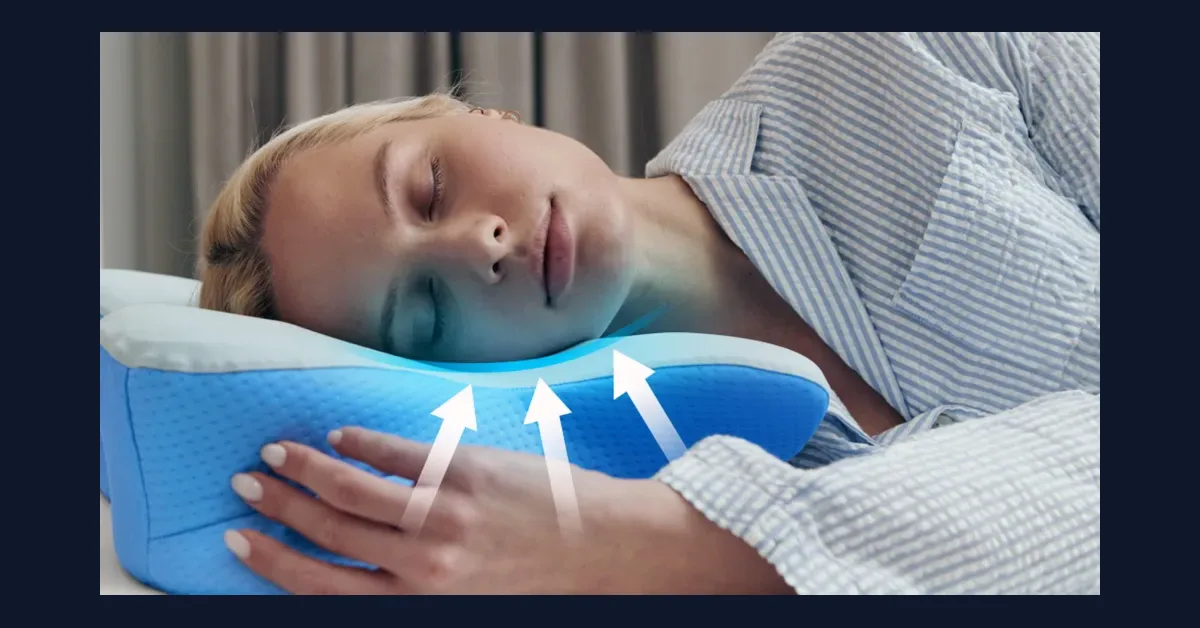
- Set the pillow by the gap, not the label. On your side, the gap between your ear and the mattress is roughly the width of your shoulder, so the pillow has to be thick enough to keep your nose in line with your breastbone. On your back, that gap is much smaller, so the same pillow will push your chin toward your chest. Different position, different height.
- Fill the hollow under the neck. Roll a hand towel into a sausage about the thickness of your wrist and tuck it into the bottom edge of your pillowcase, so it sits under the curve of your neck rather than under your skull. If that alone lets you settle, the problem was support, not position.
- Put a pillow between your knees if you are a side sleeper. It stops the top leg dragging your pelvis forward, which stops your spine twisting, which takes load off the top of the chain. Back sleepers: a pillow under the knees if the lower back complains.
- Make it easy to move. One duvet you can throw off, a bed you can turn over in, and no arm trapped under the pillow. The Cary 2021 finding was about time spent stuck in one awkward posture (Cary et al., 2021) — movement is the countermeasure, and a bed that lets you move is part of the plan.
- Give each position minutes, not hours. If a position clearly worsens pain or tingling within minutes, it is the wrong position for tonight. Change it rather than enduring it.
The 60-second setup check
Lie down, close your eyes, and ask four questions. Is my nose in line with my breastbone (side) or is my chin level (back)? Is my neck supported along its curve, or is there a hollow under it? Is my top shoulder relaxed, or hiking toward my ear? Can I turn my head a little both ways without a sharp pull? If any answer is no, adjust the pillow before adjusting the position. Repeat the check after any change, and again in the morning.
How to sleep with a stiff neck
A stiff neck needs the same plan with two adjustments: more heat, and lower expectations for tonight. This section answers “how to sleep with a stiff neck” as its own question, because the stiff-neck reader is not choosing between positions in the abstract — they cannot turn their head, and they want to know what to do about that, tonight.
First, the timeline, so tonight has context. A sudden wry neck usually improves within a few days, per a Royal Berkshire NHS leaflet (2024) (Royal Berkshire NHS, 2024). Muscular neck pain usually becomes worse over the first 24 to 36 hours, then gradually gets better over 1 to 2 weeks, per a Birmingham Women’s and Children’s NHS leaflet (Birmingham Women’s and Children’s NHS, n.d.). Day one is usually the worst, and the first-night plan is about getting through it, not fixing it.
For tonight specifically: use heat before bed — a heat pack or hot water bottle, not put straight on the skin — then lie on the side that moves more freely — not the stiff side — with the neck supported and the painful side up. Do not force the stiff side down onto the pillow hoping to stretch it out; the stretch happens over days, not in one night. Keep the room warm and the duvet light enough to turn over. Gentle movement before bed helps more than stillness: slow turns within the pain-free range, a few shoulder rolls, and nothing forced through sharp pain. A short course of an over-the-counter pain reliever, if it is safe for you, can be the difference between lying awake and falling asleep — follow the packet and your own medical history.
What not to do with a stiff neck tonight: do not sleep on your stomach, do not stack pillows to prop the head up, do not crack or yank the neck, and do not lie rigidly still trying to protect it. Stillness is what the neck does not need, and the leaflets advise normal activity plus gentle movement rather than bed rest (Birmingham Women’s and Children’s NHS, n.d.). If the stiffness is worst on waking and eases during the day, the sleep setup is part of the cause — see why do I wake up with a stiff neck every morning? — and if it is not clearly better within a week, see a GP rather than waiting longer. The full duration question, with checkpoints, is on how long does a stiff neck last?
How to relieve neck pain from sleeping wrong
“Sleeping wrong” usually means one of three things: the neck was rotated or bent for hours, the pillow was the wrong height, or the arm was trapped. This section answers “how to relieve neck pain from sleeping wrong” as its own question, because the reader who slept wrong wants relief today, not a lecture on positions.
Start by naming which one it was. If the pain is on one side and the neck will not turn that way, the neck was rotated — the stomach-sleeping pattern, or a side-lying twist. If the pain is at the base of the skull with the chin tucked feeling, the pillow was too high. If the arm is numb or tingling as well as the neck hurting, the arm was trapped or a nerve is involved, and the radiculopathy guidance applies instead: how to sleep with cervical radiculopathy.
For relief today: warmth on the neck, gentle movement little and often within the pain-free range, and normal daily activity rather than bed rest. The Birmingham leaflet’s pattern applies here too — muscular pain often worsens over the first 24 to 36 hours before improving over 1 to 2 weeks (Birmingham Women’s and Children’s NHS, n.d.) — so do not judge the recovery on the first day. A short course of an over-the-counter pain reliever, if safe for you, is reasonable. What helps fastest is usually the combination, not any single step: heat, then movement, then activity, repeated through the day.
For tonight, so it does not happen again: run the setup check above, fix the pillow height for your position, put the rolled towel under the neck’s curve, and start the night on your back or side rather than your stomach. Give the new setup about a week before judging it — that “about a week” is a practical heuristic, not a studied interval, and it is labelled as one here. If the same pain returns morning after morning despite a corrected setup, the cause is probably not the night’s sleep at all, and the driver is daytime: screen height, stress, or an underlying neck problem that needs a clinician’s look. See neck pain from pillow for the pillow diagnosis in full, and how long does a stiff neck last? for the checkpoints.
Mistakes, myths, and what not to do
Myth: there is one perfect position, and you must hold it all night. The Cary 2021 finding was about time spent stuck in awkward postures (Cary et al., 2021), not about a single wrong position. A good night includes movement. Choosing a position and then lying rigidly in it all night misses the point.
Myth: a new pillow will fix it tonight. The reviews found small effects and no winning material (Pang et al., 2021) (Ghosh et al., 2025). A pillow change is a reasonable experiment over a week, not a tonight fix. The tonight fixes are free: heat, the rolled towel, the arm support, and the position change.
Mistake: sleeping with the arm under the head. It feels comfortable for about a minute, then compresses the nerves and blood vessels of the arm and shoulder for hours. If you wake with a numb arm, the arm position is the first suspect, not the mattress. See why does my arm go numb when I sleep on my side?
Myth: cold is always better than heat, or the reverse. Neither has a trial proving it superior for ordinary neck pain. Heat suits the stiff, achy, muscular kind; cold suits sharp, freshly strained pain. Try one, and if it does not help within a day, try the other.
Mistake: changing position and pillow on the same night. If mornings improve, you will not know which change did it. Change one thing at a time, give it about a week, and track the morning score from 0 to 10.
What the evidence cannot tell you
The limits on this page are the reason its advice is framed as a structured experiment rather than a prescription.
- No randomised trial of sleep positions for neck pain exists. Everything here is observational or laboratory work. A trial that assigns people with neck pain to back, side, or stomach sleeping and follows them for weeks would settle the ranking; nobody has run it.
- The best study cannot prove causation. Cary 2021 filmed 53 people, only 13 with cervical symptoms, and its design is cross-sectional (Cary et al., 2021). People in pain may move less because they hurt, rather than hurting because they move less.
- The height numbers come from small laboratory studies of healthy people. Ren 2016 (10 volunteers), Tian 2025 (9 side sleepers), Kim 2015 (16 young adults) (Ren et al., 2016) (Tian et al., 2025) (Kim et al., 2015). None had neck pain, and none slept at home.
- Long-term outcomes are unmeasured. No study on this page follows people for months to see whether a position or pillow change keeps working. Track your own mornings for a month; if the benefit fades, the setup was not the driver.
- The prognosis qualification applies here too. A 2011 systematic review (Hush et al., 2011) found average pain still 42 out of 100 at 12 months for people with acute neck pain (Hush et al., 2011). The pooled average fell from 64 at onset to 35 at 6.5 weeks but stayed at 42 at 12 months — improvement is common, full resolution is not guaranteed, and a flat recovery line needs assessment rather than another week of sleep experiments.
What would settle it is a randomised trial of sleep position in people with neck pain, with pillow height standardised and symptoms followed for at least a month. Until then, the honest advice is a structured experiment on yourself: fix the pillow, try one position for about a week, track mornings, and let your own data decide.
When to get care
The tonight plan is for ordinary muscular neck pain. These are the exceptions, and they outrank it.
- Arm numbness, tingling, or weakness down one arm — see how to sleep with cervical radiculopathy. Nerve symptoms are a different problem from a stiff neck.
- Fever with a stiff neck — same-day urgent care; possible meningitis.
- Pain after a serious injury, such as a car accident or a fall — get assessed promptly rather than experimenting with positions.
- Stiffness that does not improve over weeks, or keeps coming back every few weeks — the timeline has stopped fitting. See how long does a stiff neck last? for the checkpoints.
- Morning headaches with the neck pain — see why do I wake up with a headache every morning?.
For the full warning-signs picture, see neck pain warning signs: when to stop self-managing.
Key takeaways
- Sleep on your back or side, not your stomach, with the neck level and the pillow filling the gap between head and mattress.
- People who woke with neck symptoms spent a median of 185.1 minutes in provocative postures against 83.8 minutes for controls — but the study cannot prove posture caused the pain (Cary et al., 2021).
- Tonight’s free fixes: heat before bed, a rolled towel under the neck’s curve, supported arms, and a bed that lets you move.
- A stiff neck needs the same plan with more heat and lower expectations: a wry neck usually improves within days (Royal Berkshire NHS, 2024).
- Pain from sleeping wrong eases with heat, gentle movement, and normal activity; muscular pain often worsens for 24 to 36 hours first (Birmingham Women’s and Children’s NHS).
- No pillow type is clearly superior (Pang et al., 2021; Ghosh et al., 2025) — set the height, then judge by morning pain over about a week.
Questions people actually ask
How do I sleep with neck pain?
What is the best way to sleep with a stiff neck?
How do you fix neck pain from sleeping wrong?
Should I use heat or ice for neck pain before bed?
What exercises help neck pain before sleep?
Can I sleep on my stomach with neck pain?
How long should I try a new sleep setup before judging it?
Keep exploring: your next question
References
- Cary, D., Jacques, A., & Briffa, K. (2021). Examining relationships between sleep posture, waking spinal symptoms and quality of sleep: a cross sectional study. PLOS ONE, 16(11), e0260582. PubMed: 34847195 / PMC8631621
- Cary, D., Briffa, K., & McKenna, L. (2019). Identifying relationships between sleep posture and non-specific spinal symptoms in adults: a scoping review. BMJ Open, 9(6), e027633. PubMed: 31256029
- Pang, J. C. Y., Tsang, S. M. H., & Fu, A. C. L. (2021). The effects of pillow designs on neck pain, waking symptoms, neck disability, sleep quality and spinal alignment in adults: a systematic review and meta-analysis. Clinical Biomechanics, 85, 105353. PubMed: 33895703
- Ghosh, S., Goyal, M., & Goyal, K. (2025). Effect of pillow on pain, disability and sleep quality in patients with chronic neck pain: a systematic review. Rehabilitación, 59(3), 100922. PubMed: 40633255
- Ren, S., et al. (2016). Effect of pillow height on the biomechanics of the head-neck complex. PeerJ, 4, e2397. PubMed: 27635354 / PMC5012320
- Tian, S., et al. (2025). The individualized optimal pillow height and neck support design for side sleepers. Medical & Biological Engineering & Computing, 63(2), 535–544. PubMed: 39412632
- Kim, H. C., et al. (2015). The effect of different pillow heights on the parameters of cervicothoracic spine segments. Korean Journal of Spine, 12(3), 135–138. PubMed: 26512267 / PMC4623167
- Gordon, S. J., Grimmer-Somers, K., & Trott, P. (2010). Pillow use: the behavior of cervical stiffness, headache and scapular/arm pain. Journal of Pain Research, 3, 137–145. PubMed: 21197317
- Royal Berkshire NHS Foundation Trust. (2024). Acute torticollis (wry neck) [Patient leaflet]. Royal Berkshire NHS
- Birmingham Women’s and Children’s NHS Foundation Trust. (n.d.). Neck sprain or pain [Patient leaflet]. Birmingham Women’s and Children’s NHS
- Hush, J. M., et al. (2011). Prognosis of acute idiopathic neck pain is poor: a systematic review and meta-analysis. Archives of Physical Medicine and Rehabilitation, 92, 824–829. DOI: 10.1016/j.apmr.2010.12.025
Last updated: 2026-11-21 by Adeel Farooq
Published 21 November 2026 — new page (gap G11 anchor, with sections for ranks 13 and 15). Images reuse existing neck-pain assets; dedicated photography to be added later.
How we researched this page
We mapped 7 reader questions for this page from collected “people also ask” queries and live search results for “how to sleep with neck pain”, “how to sleep with a stiff neck”, and “how to relieve neck pain from sleeping wrong” (21 November 2026), then traced every claim to 11 sources. The live SERP is mixed — GoodRx and MedicalNewsToday hold the top spots above small sites — and the page is built as informational tonight-plan content. No manufacturer claims were used as evidence. Counts verified November 2026. Full method: how we research.